


Which AEO services actually move the needle for a U.S. small business? The ones that make your answers easy for AI to extract and trust: answer-first content built around real customer questions, structured data (FAQ, Article, and Organization schema), a clean technical foundation that lets AI crawlers in, a well-optimized Google Business Profile, and citation tracking across ChatGPT, Perplexity, and Google AI Overviews. You don’t need all of them at once — you need them in the right order.
Search changed underneath everyone. Roughly 40% of information-seeking queries now begin inside an AI interface rather than a traditional results page, and when someone asks ChatGPT or Google’s AI Overview “who’s the best web developer for my business,” the answer names a handful of sources — not ten blue links. Answer Engine Optimization (AEO) is the work of becoming one of those cited sources. Below is what that work actually consists of, which services matter for a small business specifically, and how to sequence them.
What “AEO services” really means (and what it doesn’t)
AEO isn’t SEO with a new sticker on it, but it isn’t a separate universe either. For Google AI Overviews, roughly three-quarters of what gets cited overlaps with the traditional top-10 results — so good SEO still feeds AI visibility. The gap shows up on ChatGPT and Perplexity, where citation depends on signals traditional SEO never optimized for: self-contained answers, entity clarity, brand mentions across the web, and whether AI crawlers can even read your site. AEO services close that gap.
Here are the service categories that matter, in the order a small business should usually tackle them.
1. AI crawler access — the binary gate
This is the cheapest, highest-leverage fix, and most small businesses never check it. AI engines each use their own crawler: GPTBot and OAI-SearchBot (ChatGPT), PerplexityBot (Perplexity), ClaudeBot (Claude), Applebot (Apple), plus Google’s own. If any are blocked in your robots.txt, you’re invisible to that engine no matter how good your content is. It’s a small slice of the overall picture but it’s pass/fail: blocked means zero citations, full stop.
What the service looks like: an audit of robots.txt and server rules, confirming the major AI bots are allowed, plus submitting your sitemap to Bing Webmaster Tools — because ChatGPT’s search pulls heavily from Bing’s index, with studies showing up to ~87% overlap between Bing’s top results and ChatGPT’s citations.
2. Answer-first content architecture
AI engines don’t read your page the way a person browses it. They break the user’s question into several sub-queries (a technique called “query fan-out”), search each one, and extract the clearest self-contained passage they can find. If your answer is buried three paragraphs down after a story about your company’s founding, it won’t get pulled.
The service here is restructuring content so every important page leads with a 40–60 word “answer capsule” — a direct, quotable response to the exact question a customer asks — followed by the supporting detail. Question-based subheadings, short paragraphs, and a specific fact or number in each answer all raise the odds of extraction. For a small business, this usually means rewriting your core service pages and building a small library of genuinely useful question-and-answer content (exactly like the Knowledge Base this article lives in).
3. Structured data (schema) that matches your content
Schema markup is how you hand AI systems a machine-readable map of who you are and what each page says. FAQ schema marks your question/answer pairs. Article schema identifies your posts and their author. Organization schema ties your name, logo, and profiles together into a single entity Google’s Knowledge Graph can trust. Nested schema that connects these creates entity relationships AI engines actively look for when deciding who’s authoritative.
One rule that protects you: only mark up content that’s actually visible on the page, and validate everything with Google’s Rich Results Test. Schema that describes things a reader can’t see — or invented ratings — is a guideline violation that can get you penalized rather than cited.
4. Google Business Profile optimization (for local visibility)
Nearly half of Google searches have local intent, and AI Overviews pull directly from Google Business Profiles to answer them. For a service-area small business, your GBP is often your single most important AI-visibility asset. Google’s AI weighs freshness heavily — profiles that haven’t posted in 30+ days see visibility drop — and in 2026 its vision systems actively read your photos to verify category and services.
What the service looks like: keeping hours, services, and products complete and current; posting regularly; adding fresh, real photos; and managing reviews, which AI reads for sentiment and trust signals.
5. Citation tracking and measurement
You can’t improve what you can’t see. Traditional rank tracking doesn’t tell you whether ChatGPT mentioned you. AEO measurement services watch three things: where your brand appears across AI answer engines (share of voice), which of your pages get cited, and referral traffic from AI sources — ChatGPT, Perplexity, and Copilot each show up as distinct referrers in analytics. Google Search Console still matters too: high impressions with low clicks often means you’re being summarized in an AI Overview.
How to sequence this for a small business
You don’t buy all five at once. A sensible order: fix crawler access first (fast, binary), then structure your highest-value pages answer-first with matching schema, then optimize your Google Business Profile if you serve a local market, and finally put tracking in place so you can see what’s landing. Most businesses see measurable movement in AI Overview appearances within three to six months — technical fixes show faster, content authority compounds over time.
Where Tony Web Studio fits
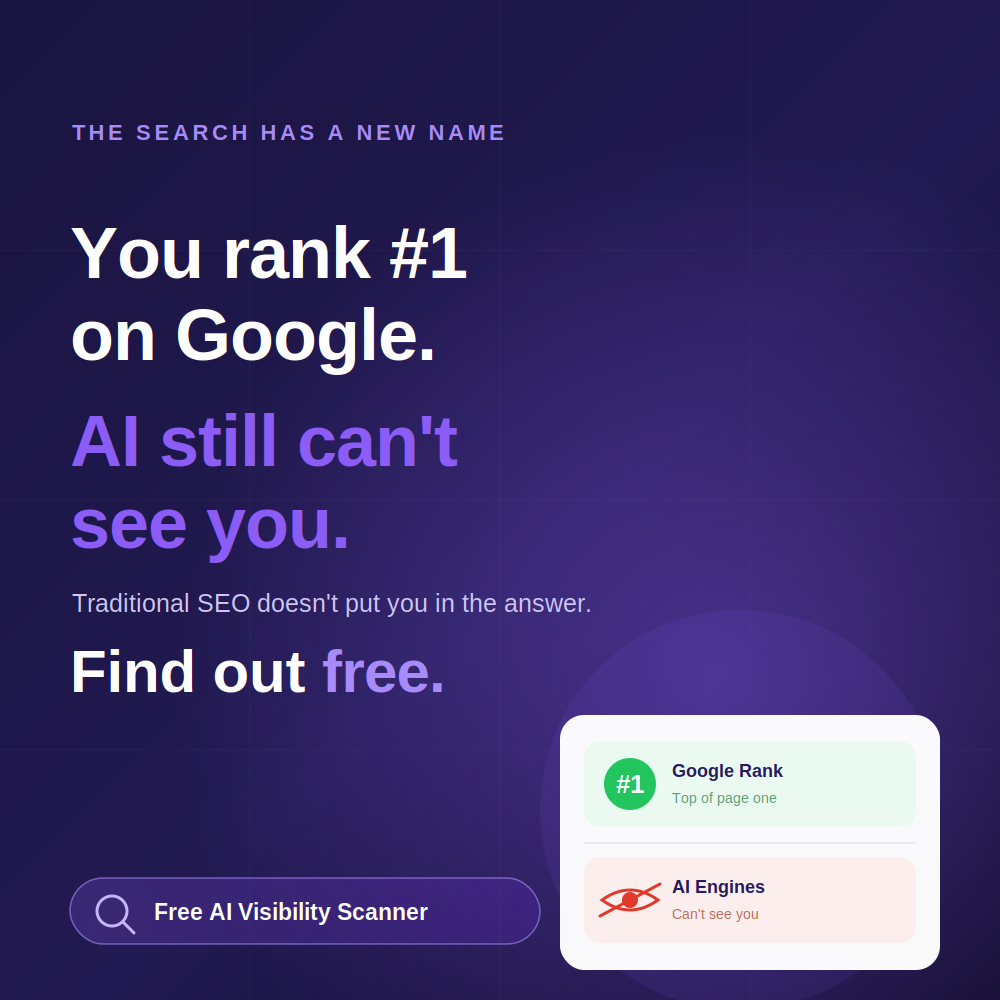
Tony Web Studio builds AEO and AI-visibility programs for U.S. small businesses — the crawler audit, the answer-first content and schema, the Google Business Profile work, and the citation tracking, sequenced so you’re not paying for everything before the foundation is in place. The goal is simple: when your customer asks an AI who to hire, your business is in the answer. If you want to see where you stand today, our free AI Visibility Scanner runs your site and your competitors through the major engines and shows you exactly what they can and can’t see.
Frequently asked questions
What is Answer Engine Optimization (AEO)?
AEO is the practice of structuring your website and content so AI answer engines — ChatGPT, Perplexity, Claude, Gemini, and Google AI Overviews — cite your business when people ask them questions. It focuses on making your answers easy for AI to extract, understand, and trust, rather than only ranking in traditional search results.
How is AEO different from traditional SEO?
They overlap but aren’t identical. For Google AI Overviews, most cited pages also rank well in traditional results, so SEO fundamentals still matter. But engines like ChatGPT and Perplexity add signals SEO never optimized for: self-contained answer passages, clear entity and brand associations, and whether AI crawlers are allowed to read your site. AEO addresses those additional signals on top of solid SEO.
How long does it take to show up in AI search overviews?
Most small businesses see measurable improvement in AI Overview appearances within three to six months. Technical fixes such as crawler access and schema tend to show results faster, while content authority and brand mentions build up progressively over a longer timeline.
Do I need to allow AI crawlers on my website?
Yes. Each engine uses its own crawler — GPTBot and OAI-SearchBot for ChatGPT, PerplexityBot for Perplexity, ClaudeBot for Claude, and others. If your robots.txt blocks them, that engine cannot cite you regardless of how good your content is. Allowing the major AI crawlers is a small but pass/fail requirement.
Which AEO service should a small business start with?
Start with the fast, binary fix: confirm AI crawlers can access your site and submit your sitemap to Bing Webmaster Tools. Next, restructure your most important pages to lead with clear answer capsules and add matching schema. If you serve a local market, optimize your Google Business Profile. Finally, add citation tracking so you can measure which pages AI engines are citing.
Does Answer Engine Optimization work for local businesses?
Yes, and often dramatically. Nearly half of Google searches have local intent, and AI Overviews pull directly from Google Business Profiles to answer them. A complete, regularly updated profile with fresh photos and managed reviews is one of the strongest local AI-visibility signals a service-area business can invest in.